
25 rucking goals, from your first walk with a pack to a 100 km month
· 5 min read
Rucking is walking with weight on your back. Good rucking goals count three things: kilometres, kilos in the pack and rucks done. Change one of them at a time. Here are 25 ideas for beginners and regulars, from a first 3 km with a light pack to a 100 km month and a 12 mile march.
Contents
Rucking for beginners
A first ruck can be a walk you already take, with some weight added in a backpack: tying a new habit to an old one is the idea behind habit stacking.
- Ruck 3 km with 5 kg in a backpack you already own.
- Ruck twice a week for 4 weeks on the same route with the same weight.
- Ruck for 30 minutes without stopping.
- Pack the heaviest item close to your back and fasten the hip belt on every ruck for a month.
- Do 10 rucks before you add any weight.
Rucking distance goals
Distance goals add kilometres while the pack stays the same, and they count what you carry where the walking challenge ideas count steps.
- Add 1 km to your longest ruck each week until it reaches 10 km.
- Ruck 5 km, then 8 km, then 12 km, with the same pack weight.
- Ruck 20 km in one day.
- Ruck 25 km over one weekend, split across 2 days.
- Ruck the same 5 km route 10 times and finish the last one 5 minutes faster than the first.
Rucking weight goals: how much weight to add
Weight goals add kilos while the route stays the same, and since there is no official starting weight, every number below is an example, not a rule.
- Weigh your full pack on a bathroom scale before every ruck for a month.
- Ruck 4 times in a row at one weight before you add 2 kg.
- Ruck your usual 5 km route with 10 kg.
- Ruck 10 km with 10 kg.
- Ruck 5 km with 15 kg, 6 months after your first ruck.
Ruck challenges: monthly kilometres, 100 km months and marches
A ruck challenge is a total or a test with a date, like the US Army's Expert Infantryman Badge march, which the Army described in 2017 as 12 miles in 3 hours or less, with a 35 lb pack and combat gear.
- Ruck 100 km in one month.
- Ruck on 20 days out of 30.
- Ruck 365 km in a year, 1 km for each day.
- Ruck 19.3 km (12 miles) in 3 hours or less with 16 kg (35 lb) on your back.
- Finish one organised ruck or march event this year.
Weighted vest walking and everyday rucking
A weighted vest is the same idea with the load worn on your chest and back, and everyday rucking puts the kilometres into trips you already make.
- Walk 30 minutes in a 5 kg weighted vest, 3 times a week for 4 weeks.
- Walk 100 km in a weighted vest over 3 months.
- Walk the dog with your pack on, 5 days a week for a month.
- Ruck to work, school or the shop instead of driving, once a week for 3 months.
- Take 10 phone calls a month on a ruck instead of at a desk.
What is a good rucking goal?
A good rucking goal counts one thing: kilometres, kilos or rucks done. A review of 35 years of goal research found that specific, hard goals lead to higher performance than being told to do your best. "Ruck more" has no finish line. "Ruck 100 km by 31 March" does.
Then change one thing at a time. A review of soldier load carriage found that the energy cost of walking with a pack goes up with the weight carried, the walking speed and the slope. It also found that a load kept close to the body costs the least energy, that a hip belt takes pressure off the shoulders, and it lists foot blisters, back strain and knee pain among the common injuries of long marches with a load. There is no official starting weight, and this page gives none: the kilos in the ideas are examples.
Rucking is walking, so a brisk ruck counts like any brisk walk. The CDC says adults need 150 minutes of moderate activity a week, such as brisk walking, plus 2 days of muscle-strengthening activity. On a plan built around Hyrox goals or wrestling goals, a ruck can fill one of the lighter days.
How to track rucking goals
Log each ruck when you get home: the kilometres, the kilos and the time. A review of 138 studies found that people who monitored their progress reached their goals more often, and that recording it beat keeping it in your head.
Kilometres are an amount that adds up toward a total, like 100 km in a month. Rucks are a day count, like 20 days out of 30. Write the pack weight next to each ruck, so you can see when you last changed it. Three months of either shape also make a good winter arc.
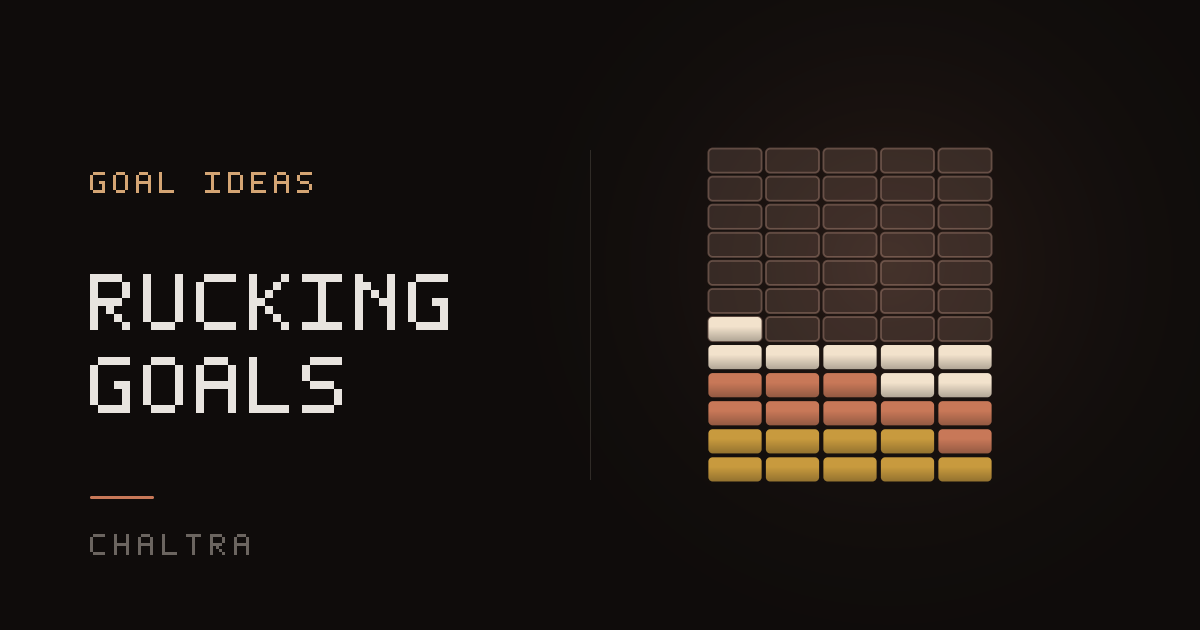
A 100 km month is too long to hold in your head. A brick wall that rises with every kilometre shows it one row at a time.
Frequently asked questions
- How much weight should I use for rucking as a beginner?
- There is no official starting weight, and this page does not set one. Start lighter than you think you need, keep the same weight for several rucks, then add a little. The 5 kg in the ideas above is an example, not a rule.
- How far should a beginner ruck?
- Start with a route you already walk without a pack, for example 3 km, and make it a little longer each week. Change the distance or the weight, not both at once.
- Is walking with a weighted vest the same as rucking?
- Close. Both are walking with extra weight. A backpack carries the load on your back, and its hip belt takes some of it off your shoulders. A vest spreads it over your chest and back. Goals for both count the same things: kilometres, kilos and walks.
Sources
- Knapik, Reynolds & Harman (2004), Soldier load carriage: historical, physiological, biomechanical, and medical aspects. Military Medicine 169(1), 45-56
- U.S. Army (2017), Expert Infantryman Badge training increases Soldiers, unit readiness
- CDC, Adult activity: an overview
- Locke & Latham (2002), Building a practically useful theory of goal setting and task motivation: a 35-year odyssey. American Psychologist 57(9), 705-717
- Harkin et al. (2016), Does monitoring goal progress promote goal attainment? Psychological Bulletin 142(2), 198-229
Keep reading
Goal ideas · 4 min read
25 hiking goals for distance, summits and a year on the trail
25 hiking goals for beginners and regular walkers. Distance, climbing, summit and year long examples, plus how to choose one and keep count of it.
Goal ideas · 4 min read
30 fitness goals examples you can measure, from beginner to gym regular
30 fitness goals examples for beginners and gym regulars. Strength, cardio, flexibility and 30 day challenge ideas, and how to pick one you can measure.
Guide · 4 min read
30 day challenge ideas, and how to pick one you will finish
A list of 30 day challenges for fitness, money, mind and skills, plus how to pick one you will finish and how to track it without an app.