
The 10,000 hour rule: is it true, how many hours a day, and 25 goals
· 5 min read
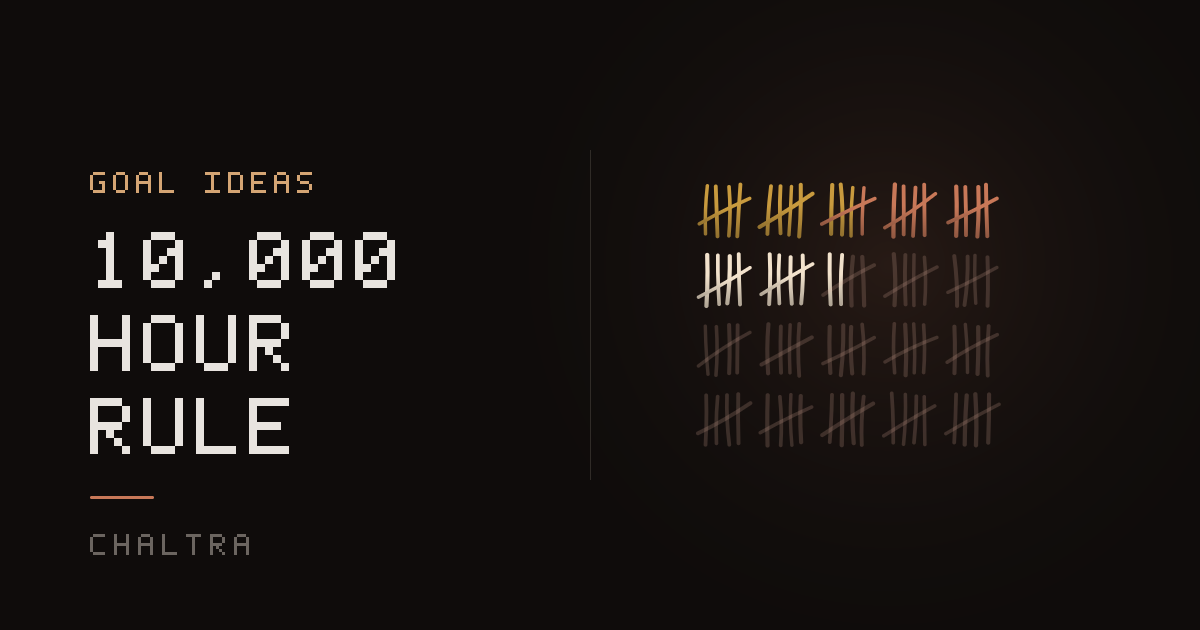
The 10,000 hour rule says it takes about 10,000 hours of practice to become an expert. It is a rough number, not a law. That is 2.7 hours a day for 10 years, or 27 years at one hour a day. Here are 25 practice goals in hours you can actually count.
Contents
- How many hours a day is 10,000 hours?
- Smaller hour goals: 20, 100 and 1,000 hours
- 10,000 hour rule examples: hour goals by skill
- What counts as an hour: goals for better practice
- How to count your hours
- Is the 10,000 hour rule true?
- Where did the 10,000 hour rule come from?
- How to track practice hours
- Frequently asked questions
How many hours a day is 10,000 hours?
10,000 hours sounds like a lot, and it is. Split by day, it shows how long the road is.
- Practise 1 hour a day, every day: 10,000 hours takes 27.4 years.
- Practise 2 hours a day: 13.7 years.
- Practise 3 hours a day: about 9 years.
- Practise 20 hours a week: 500 weeks, or 9.6 years.
- Practise 40 hours a week, like a full-time job, for 50 weeks a year: 5 years.
Smaller hour goals: 20, 100 and 1,000 hours
You do not need 10,000 hours to get good at something. A smaller number you can finish this year is a better first goal. If you like counting days instead, a 100 day challenge works the same way.
- 20 hours in 30 days: 40 minutes a day for a month.
- 50 hours: 10 minutes a day for 300 days.
- 100 hours in a year: 17 minutes a day makes about 103 hours.
- 500 hours in a year: 1 hour and 23 minutes a day.
- 1,000 hours in a year: 2 hours and 45 minutes a day. Or 1 hour a day for 1,000 days, about 2 years and 9 months.
10,000 hour rule examples: hour goals by skill
The same math works for any skill. For full lists, see these guitar goals and these language learning goals.
- Guitar: 30 minutes a day is 182.5 hours in a year.
- A new language: 20 minutes a day is about 122 hours in a year.
- Drawing: 1 hour on 5 days a week is 260 hours in a year.
- Chess: 45 minutes a day is about 274 hours in a year.
- Coding: 2 hours on every weekday is 520 hours in a year.
What counts as an hour: goals for better practice
Research on practice talks about deliberate practice: working on what you cannot do yet, with a goal and some feedback. These goals make an hour count.
- Start each session with 10 minutes on the one thing you got wrong last time.
- Record yourself once a week and write down 3 mistakes to fix.
- Get feedback from a teacher, coach or better player 12 times this year.
- Play or do a hard part slowly 5 times in a row with no mistakes before you speed up.
- Count only focused time: a timer running and the phone in another room.
How to count your hours
Hours are easy to lose track of. A few simple habits keep the total true.
- Write down your hours the same day you practise, in quarter hours.
- Start with a 100-hour target, and raise it when you reach it.
- Check your total once a week: are you on pace for this month?
- Mark each tenth of your target as a small win.
- Keep one line about what each session was for, so you can see where the hours went.
Is the 10,000 hour rule true?
Not as a rule. Practice matters, but how much it matters depends on the skill. A review of 88 studies found that deliberate practice explained about 26 percent of the differences in performance in games like chess, 21 percent in music, 18 percent in sports, 4 percent in education and less than 1 percent in jobs.
A later review of sports found the same 18 percent overall, and about 1 percent among top athletes. So hours help a lot, and most of the difference still came from other things.
That is why no single number can tell you when you will be an expert. In chess, practice explains more than in most fields. In many jobs, it explains much less.
Where did the 10,000 hour rule come from?
The number comes from studies of top performers, such as young violinists, who had built up many thousands of hours of practice. Malcolm Gladwell's 2008 book Outliers made it famous as the 10,000 hour rule.
In the research, 10,000 was a rough figure for how much some of the best had practised. It was never a line you cross to become an expert. Some people get very good with far fewer hours, and some never do with many more.
How to track practice hours
Write down every hour on the day you practise, and keep a running total. A review of 138 studies found that people who monitored their progress reached their goals more often, and the effect was larger when the progress was written down.
Pick a target you can see the end of. 100 hours in a year is about 17 minutes a day. Once you reach it, set the next one.
A picture that fills a little with every hour shows the total adding up. In Chaltra, make a challenge with Hours as the unit, set a target like 20, and log each session. A challenge of up to 30 days is free. A full year needs Premium.
Frequently asked questions
- How many years is 10,000 hours?
- It depends on how much you practise. At 1 hour a day it is 27.4 years. At 3 hours a day, about 9 years. At 40 hours a week for 50 weeks a year, 5 years. Nonstop, day and night, it is about 417 days.
- How many hours a day is 10,000 hours in 10 years?
- About 2.7 hours a day, every day. In 5 years it is about 5.5 hours a day, and in 3 years about 9 hours a day.
- Is the 10,000 hour rule a myth?
- The idea that practice matters is not a myth. The idea that 10,000 hours makes anyone an expert is. Studies found practice explains a part of the difference between people, and how big that part is depends on the skill.
- Who made the 10,000 hour rule famous?
- The writer Malcolm Gladwell, in his 2008 book Outliers. The number came from research on how top performers practise.
- How many hours does it take to learn a skill?
- There is no one number. It depends on the skill, where you start and how you practise. A good first goal is 20 to 100 focused hours. That is enough to see if you like it and how fast you are moving.
Sources
- Macnamara, Hambrick & Oswald (2014), Deliberate practice and performance in music, games, sports, education, and professions: a meta-analysis. Psychological Science 25(8), 1608-1618
- Macnamara, Moreau & Hambrick (2016), The relationship between deliberate practice and performance in sports: a meta-analysis. Perspectives on Psychological Science 11(3), 333-350
- Harkin et al. (2016), Does monitoring goal progress promote goal attainment? Psychological Bulletin 142(2), 198-229
Keep reading

Goal ideas · 4 min read
25 piano goals for beginners, daily practice and your first performance
25 piano goals for beginners and returning players. Practice, pieces, technique and performance goals you can count, and what research says about practice.
Goal ideas · 4 min read
25 chess goals for your rating, your tactics and your study time
25 chess goals for beginners and club players. Rating, tactics, study and tournament goals you can count, and what research says about practice in chess.

Guide · 3 min read
Study challenge ideas built around spacing, not cramming
20 study challenge ideas, why spreading study beats cramming, how to set a daily minimum that survives exam season, and what to actually count.